Pizza in the Piazza: How Clay Sparked a Project with Two-Year-Olds
Can PBL be done with two-year-olds? My answer is a resounding YES. After years of teaching Pre-Kindergarten and resisting a new challenge of working with our youngest-age classroom, I decided I was ready for a change. I dusted off my child development textbooks, dove into current research about infancy and toddlerhood, and recognized the learning curve I was about to embark on. Certainly, I knew how this approach was to be applied with four and five-year-old children, but I quickly realized that developing and implementing PBL units looked very different with two-year-olds.
In the most obvious sense, I recognized that the two age groups have distinct developmental goals which inform nearly every choice when developing a project. I recall teaching a few Pre-Kindergarten children who arrived writing full sentences using phonetic spelling independently. I witnessed the satisfaction that 4 and 5 year-old children felt when they completed a task for a project, that they valued accomplishing their part of a whole. In contrast, two-year-olds are more invested in the process of doing, rather than what it looks like as an end product. For instance, two-year-olds value the experience of seeing their favorite color make an impression around and around on a sheet of paper, resembling a tornado. Some of the children in this class were just beginning to explore mark-making and drawing. What remained the same between the two different age groups was using the group’s unique capabilities and interests to sustain momentum in a particular topic or theme to build a project. Was the group artistic? Mathematical? Kinesthetic? I challenged myself to engage the maximum number of students around a shared goal by observing and drawing out their capabilities and interests.
Setting the Scene
My current school, The Madison Avenue Presbyterian Church Day School (MAPCDS), located in New York City, draws inspiration from the Reggio Emilia and progressive educational philosophies utilizing emergent curriculum to support project-based learning. After visiting schools in Reggio Emilia, Italy in the Fall of 2022, I was inspired by the intentional words used to distinguish different spaces. As a result, I chose to adopt the words “piazza” (which, in Italian, means a meeting place) and “atelier” (which is the name of a space that connotes a work space) to note differentiation in our classroom environments.
Our classroom layout is unique in how it resembles a New York City railroad apartment. It is composed of four smaller spaces that connect through one central hallway. This project took place in specific classroom settings including the Atelier, the Piazza - used for meetings and meals, the school’s kitchen, and Central Park.
The Story
At the beginning of the year, I offered clay in the Atelier. When I think about a material that can serve so many purposes and provides so many benefits to children, my mind always jumps to CLAY. I planned to start the year with clay as our focused art experience because it is an open-ended art material that many children do not have at home. It is a great medium to help children express themselves and clay’s texture encourages practice with key developmental tasks. It is also a wonderful sensory experience. Additionally, I put out some of the sunflowers that were donated by our classroom families and offered other natural materials such as sticks and rocks. I observed children exploring the clay and collecting the sunflower petals. What came next was a complete surprise.
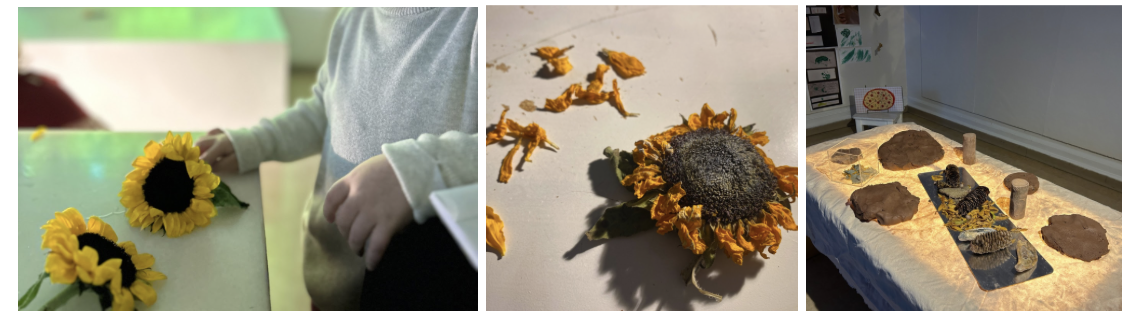
Initial activities that were set up with sunflowers and clay.
Children used the clay to make forms that they called “pizza.” I asked, "What do you put on a pizza?” Children used the sunflower petals to sprinkle them on top of their flattened clay while saying, “cheese”. Their imaginative language impressed me. It was clear that they were thinking about past experiences with pizza and trying to apply this knowledge to their play. These were some of the first words that I heard from this two-year-old class. It gave me motivation to start thinking about the ways I could extend this interest in food and clay into a bigger project.
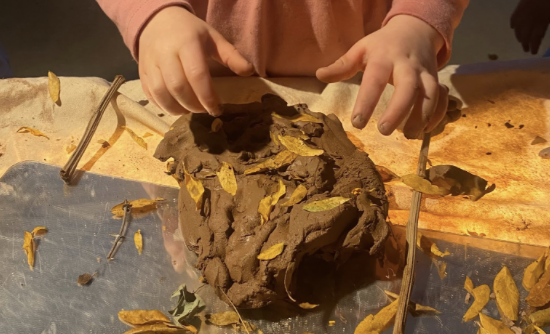
One of the first creations of “pizza with cheese” using sunflower petals and clay.
During one Morning Meeting, I taught children a song I had written about how to make pizza. Music is one of my teaching superpowers and I have always loved to sing. I titled it, “Pizza, Pizza. What Do You Need?” and it was sung to the tune of “Bah Bah Black Sheep.” The children asked to sing it at every meeting.
I could not believe that we were now months into the school year and these two-year-old children were returning to the clay day after day. When setting up my classroom, I anticipated that two-year-olds would need support sustaining attention for long periods of time. To my surprise, half the class could often be found returning to the idea of “making pizza” while at the clay table for upwards of thirty minutes. I observed children making plans about what toppings to add to their pizza or how long it may need to cook in their pretend oven. I saw children pounding the dough with their hands to create their flattened shapes while others were using tools to roll the clay back and forth until it reached their desired consistency. This helped me understand that this group of two-year-olds, like most, were tactile learners who valued open-ended sensory experiences. Every child found a way into this activity, showing me that this project was here to stay and it was up to me to figure out how to keep the momentum.
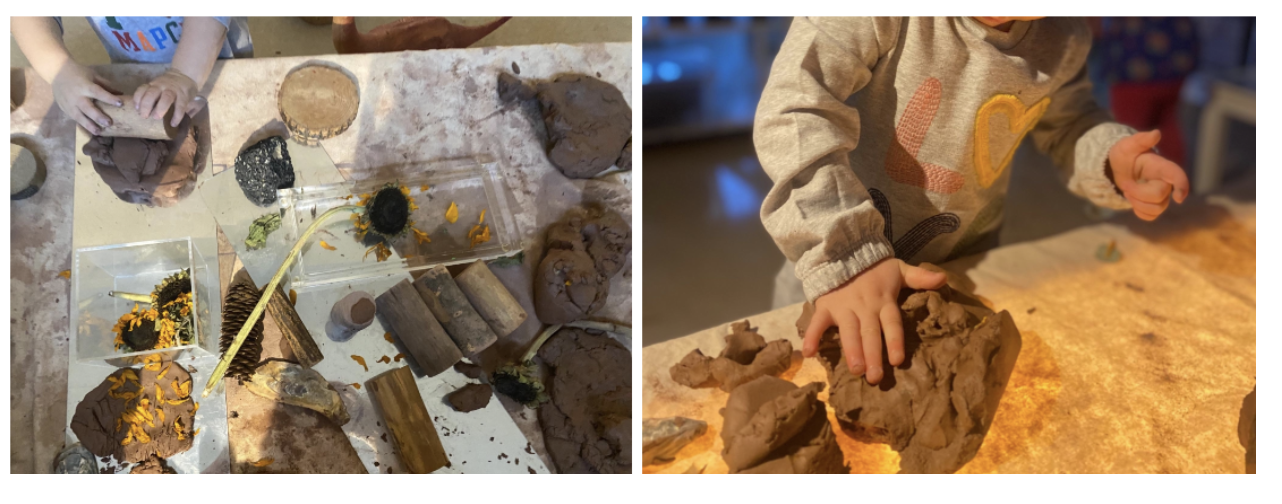
During many walks home after school, I thought to myself about how I could extend the group’s learning by cooking real pizza with the children. When I reflect on my role in project-based-learning, I intentionally aim to scaffold new experiences related to the children’s interests, motivations, and curiosities within the scope of any particular project. In fact, if school did not have finite time constraints, the best projects might never really end. If a group of children remained curious and motivated, I could argue that an educator could continue to extend and amplify those particular project learning goals. These beliefs informed my choice to transform their play ingredients into an authentic learning context that took place in a world beyond our classroom. By using our school kitchen to cook real pizza for themselves to eat, I communicated to the children that this project was significant and valued.
With that in mind, for the next step in this project, I decided to focus on how the children would explore the real ingredients of pizza. I asked myself, “What is the children’s awareness of the ingredients?” and “How familiar were the children with…
Flour
Dough
Tomato
Cheese
Basil?”
I realized by observing the children manipulating the clay and sharing dialogue about making pizza that the group was interested in feeling capable and industrious. Cooking real pizza encouraged them to exercise their desire to feel in control of their play at school. I observed them drawing connections to their own life about when they encountered one of the ingredients before. I overheard predictions about what they thought the pizza may taste like when it came out of the oven. Children wondered if it might be “Spicy” or “Crunchy.” I watched children pass tools such as rolling pins and bowls back and forth. I witnessed children form shapes with their dough and label it a “circle.”
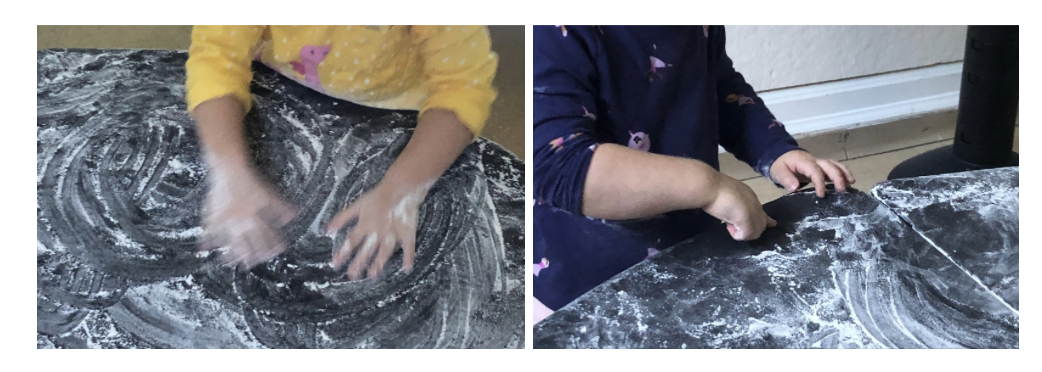
This group continued to prove to me that this project was meaningful by the amount of time they were choosing to remain in each of the activities. I reflected on my original misconceptions of this age group as I continued to collect photos, videos, and language from the project experiences. In one lesson, children moved the flour in circular motions back and forth and drew shapes with their fingers. Children smelled the flour, and called it “snow” and “sugar”. One child wondered, “Could we eat it?”. It felt as though the children were writing the lesson plans for me. Little did they know that cooking a real pizza was in the pipeline.
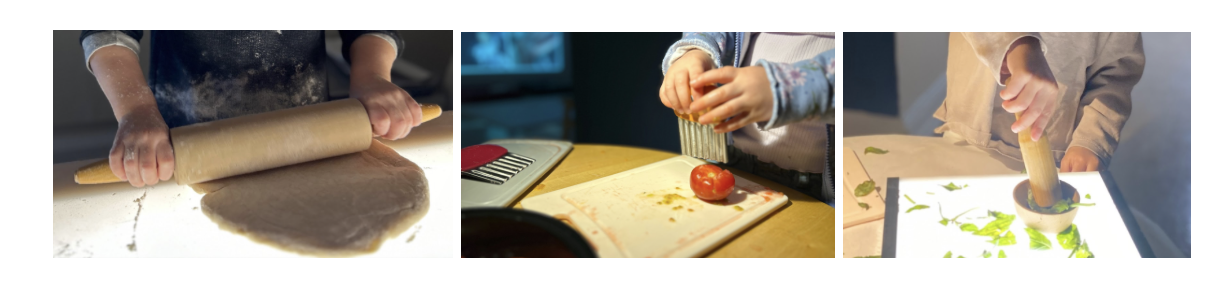
Children explored the real ingredients of pizza. Children explored flour, rolled pizza dough, cut up tomatoes, and used a mortar and pestle to grind basil.
Back in the Atelier, I asked, “Where could the oven be?” While I offered a play kitchen with a pretend oven, I observed the children making more abstract choices. The children began to bring their “pizzas”, to a nearby shelf, a small table, and even a warm overhead projector. I noticed that, once again, the children were extending this project in new ways to represent their culinary experience. I scaffolded the children’s project by asking, “How long will it take to cook?” I overheard a conversation between a few children,
“Is it ready?”
“I want to cut it”
“Don’t touch it. It's hot.”
The way in which I designed projects was completely dependent on what the children were naturally drawn to and engaging with in the classroom already. Clay and sunflower petals magically transformed into pizza, creating unstoppable momentum to help me build an artistic and culinary project starring a delicious and popular meal. And after many meal times together, we spent the rest of our school year making real pizzas every week to share with the other classrooms in our school.
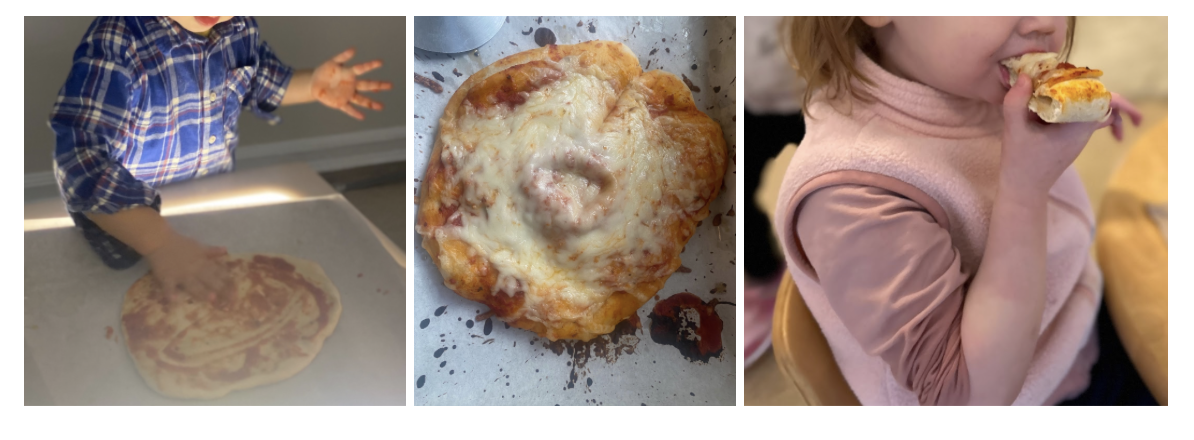
Children participated in preparing pizza and eating it during meal time. We went on to make pizzas for other classrooms in our school.
Pizza in the Piazza began when a child made a connection between clay and pizza. From that point, the children became the leaders of the project. I created extensions and expansions, designing a transdisciplinary, multi-sensory project that involved art, cooking, nature, and community. I assessed differentiation, inclusion, and motivation through documented written notes, children’s artifacts, photographs, and videos. Each of the offerings was designed to connect to specific developmental objectives and individualized goals. Children strengthened fine motor skills by rolling and pinching clay, expanded expressive vocabulary through conversations about pizza, and advanced cognitive skills through scaffolded imaginative play. Each component of Pizza in the Piazza targeted more than one developmental area, a fundamental benefit of project-based learning. And all of it was deeply rooted in the children’s natural drive and interest in their play.
Tips for Implementing PBL with Toddlers
1. Begin with a Shared Sensory Experience
When working with toddlers, I suggest starting the year with a main sensory experience (i.e. water, sand, soil, clay, etc). Preferably, place the sensory experience in the middle of the room where children can gather around it from all sides, rather than flanking it against a wall. This shows children that it is a welcoming activity and encourages a larger group to participate. Next, choose a number of materials that can be used to manipulate that sensory material such as a colander and cups for a water table, or spray bottles for sand. There should be enough materials so each toddler can hold tools in both hands. This choice supports PBL because it invites a central focus while remaining open-ended. As educators, we can facilitate choice while also supporting a focused project and theme.
2. Listen for Language that Launches Projects
When creating projects for this age group in particular, I suggest writing down the common words children say. These can often be used to launch a project. Projects with this age group work best when the group is already interested and curious about a topic.
3. Narrate Learning as It Happens
With the youngest learners in PBL, one powerful practice is to narrate your observations aloud. What do you feel when you touch the materials in the activity? What do you hear? What do you see? By narrating your interactions, children will see that as a model for their own communication. For example, “I see a child touching the clay. The clay feels wet today. I hear the clay making a squishing sound. Squish! Squish! I see a child rolling the clay. I hear a child pounding the clay. Boom! What do you see? What do you hear? What do you feel?”
Use Sensory Language to Scaffold Dialogue
By incorporating sensorial vocabulary in order to interact with the children and the materials, you encourage, invite, and scaffold that quality of dialogue. It takes time, but you will notice more children reflecting alongside you during their play if your language remains consistent.
Stay With It
This age group benefits from repeated experiences with familiar materials. If a lesson or activity does not appear popular one day, do not get discouraged. Attempt to relaunch it again and make additional observations. For example, in this project, I chose not to change many of the materials for weeks at a time. I noticed that this age group demonstrated increased engagement when exploring familiar materials. It seemed like the more they became comfortable with materials, the deeper they connected to the project. I realized quickly that two-year-olds show you what matters to them, not as much through spoken language but instead, through DOING with their bodies.
Dana is a native New Yorker and holds her Master’s Degree in Early Childhood Education. Her career, spanning nearly a decade, centers on observing children’s play to co-construct meaningful learning experiences that foster creativity, reflection, and joy. When Dana is not in the classroom, she can be seen walking through Central Park or trying a new recipe in the kitchen. Dana’s love of cooking certainly helped propel this project. She relishes in opportunities where children of all ages can build resilience and ignite curiosity through cooking!