Designing for Everyone: Exploring Accessibility through Project Based Learning
A little over eight years ago, I began teaching first grade for the first time. My school (pre-K–grade 8) was launching Project Based Learning (PBL) and I was eager to implement it in my classroom. I was unsure how to get started and, most importantly, how to make it meaningful for my students. The Social Studies projects I had inherited were thematic in nature (our theme was “Community”) and didn’t feel connected to our students’ lives. Most activities centered on crafts and holiday projects rather than authentic investigations of our own community.
As teachers, we asked ourselves, How can we shift from this traditional thematic work around “community” to an authentic PBL experience that truly connects to our students?
Making this shift to PBL felt like building the plane while flying it, but we knew we wanted to give our students a more meaningful way to explore the Social Studies standard of understanding their place within their community. We decided to center our PBL unit on the place they were most familiar with: our school campus.
We began by helping students explore their own school community. We made campus maps with a compass rose, planned interviews with administrative staff, and collaborated with our fifth-grade "Big Buddies" to ask them what school improvements they wanted to see. Around this time, a parent in my class shared the accessibility challenges they experienced due to a visual impairment, sparking an idea that would shape our project. Our school was embarking on several campus improvements, including updating existing structures and building a new event center. But one area of our campus that was especially important to our first graders had been left out of the plan: the playground.
Developing Our Understanding
We began by asking our first graders to reflect on accessibility as they walked around the playground. “Can everyone get over this ledge? Would someone who uses a wheelchair be able to move over the wood chips? Are there any ramps people could use?” These questions led us to our Driving Question: “Is our school playground inclusive for all children?” By connecting our project to a familiar playground space, we were able to integrate the community standard from our Social Studies curriculum while developing children’s understanding of accessibility and inclusion in a developmentally appropriate way.
After determining our Driving Question, my teammate and I developed a project plan. We thought about a meaningful public product that would inspire sustained inquiry and engagement: Using our maker space, our students would design and build prototypes of accessible playground equipment, which we would then assemble into a collaborative playground model. Students would present their playground designs as a formal proposal to school administrators and potentially even board members.
We continued to plan and dream together about how to make this project cohesive. Before students could begin designing, we wanted them to develop a strong understanding of accessibility and inclusion. How could we introduce these complex concepts in a first-grade-friendly way? We turned to picture books. Some of our first-year favorites included When Charley Met Emma by Amy Webb, which explores how children with disabilities enjoy the same kinds of play as everyone else and how words like “weird” can hurt; Brontorina by James Howe, which reminds us to adapt spaces rather than expect people to change; and a parent-donated copy of Let’s Go Play by Shelby McCarthy, which introduced students to adaptive playground equipment and tools for different disabilities. Each year, we’ve added additional picture books, including What Happened to You? by James Catchpole and We Move Together by Kelly Fritsch and Anne McGuire, to continue deepening these conversations.
We also used videos to spark interest. A powerful, wordless short cartoon from Brazil called Ian, based on the true story of a child with cerebral palsy who felt excluded from a playground, was especially impactful. We even watched a Microsoft commercial highlighting adaptive gaming equipment.
After each book or video, we reflected during circle discussions, sharing our observations, thoughts, feelings, and questions. We utilized a thinking routine called “Step-In, Step-Out, Step-Back” to encourage students to think about how others might feel, ask thoughtful questions, and see things from different perspectives. We posted pictures of playground equipment under our Driving Question and asked students what they noticed, encouraging them to write and draw their ideas. These opportunities helped students build empathy and curiosity about others’ experiences.
Integrating Field Work in Neighborhood Spaces
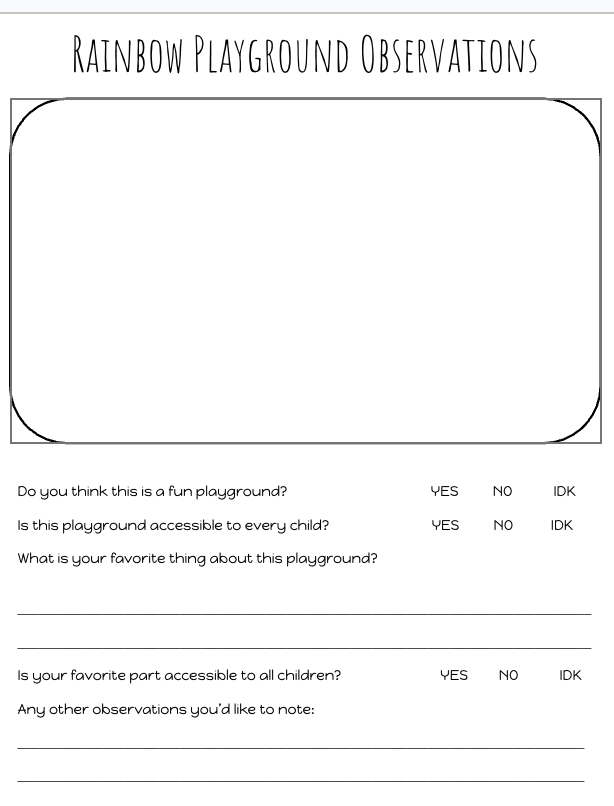
After building an understanding of these concepts, our students went out to study the playgrounds they knew best. We created a simple reflection page to help children think about playground accessibility: Students considered three questions: Is the playground accessible? Is it fun for everyone? What is your favorite part of the playground, and why?
Keeping these questions simple and consistent allowed our students to collect and compare data across different sites. First, we visited our school playground, then we walked to the neighborhood park. During a scheduled trip to the local library, we added a quick stop at the adjacent playground to eat lunch and complete the same reflection sheet. Using clipboards, paper and pencils, the students sketched their observations before heading off to play.
Our final data-collection step was to show our first graders what a fully accessible playground actually looks like. We are fortunate to live near several Magical Bridge playgrounds, which feature accessible equipment designed for inclusion. We visited the original Magical Bridge playground in Palo Alto, California, where children completed their final reflections. This time, they noticed many features they hadn’t seen before: ramps leading to playhouses, wheelchair transfer benches, scoop swings, roll-up seesaws, sensory-friendly musical features, and much more. We took dozens of photos to use as design inspiration back in our Maker Space.
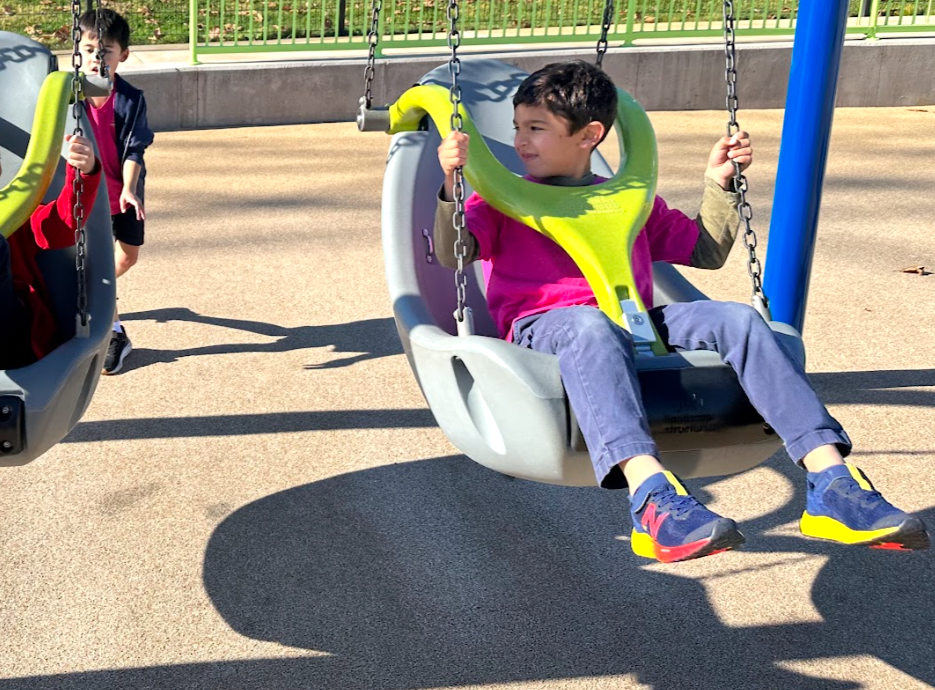
Students exploring bucket swings at the Magical Bridge Playground
Once we returned from our visits, the design and build process began. Students decided what type of equipment they wanted to create for our proposal, ranging from accessible spinners, slides, and swings to musical harps and inclusive playhouses. Each student sketched out their plans and listed the materials they thought they needed. In the maker space, they had access to cardboard, pipe cleaners, bottle caps, craft sticks, and hot glue. The build took several sessions and culminated in painting. Finally, we assembled all the individual pieces onto a square sheet of plywood we painted green and blue to represent the rubber surfacing and turf. Altogether, in our first year it took each class of 16 students two visits to our Maker Space as well as classroom time painting during afternoon center time to complete our first playground project.
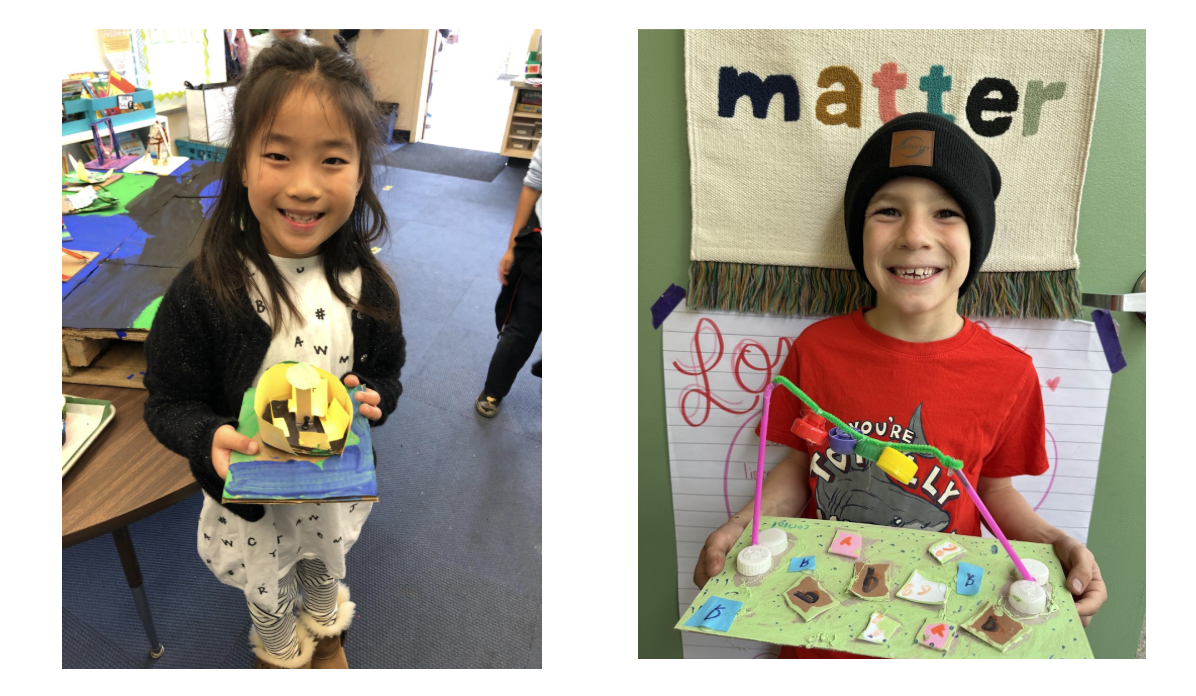
From left to right: student with a model of an accessible merry-go-round with wheelchair entrance and student with accessible laser harp.
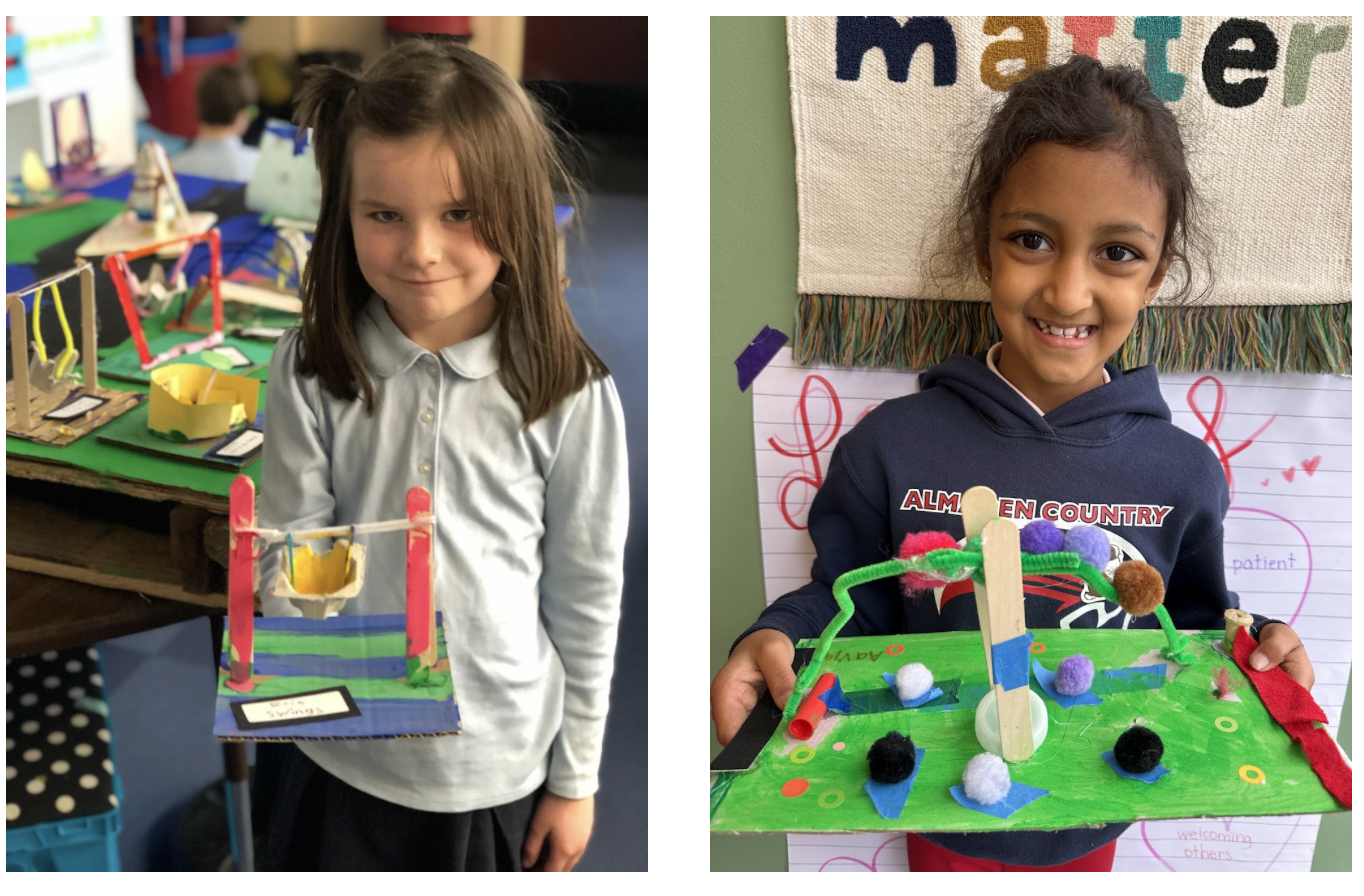
From left to right: a student with a bucket swing, and our original playground behind her, and a student with an accessible laser harp model.
The first year we completed the project, assembling the model felt like crossing the finish line. We invited our Head of School and Head of Elementary to take a tour and filmed a short video that showed the updates we hoped to see. Still, my teammate and I felt our sharing process didn't quite make the deep impact on the wider school community we were hoping for, so we made plans to expand the presentation the following year.
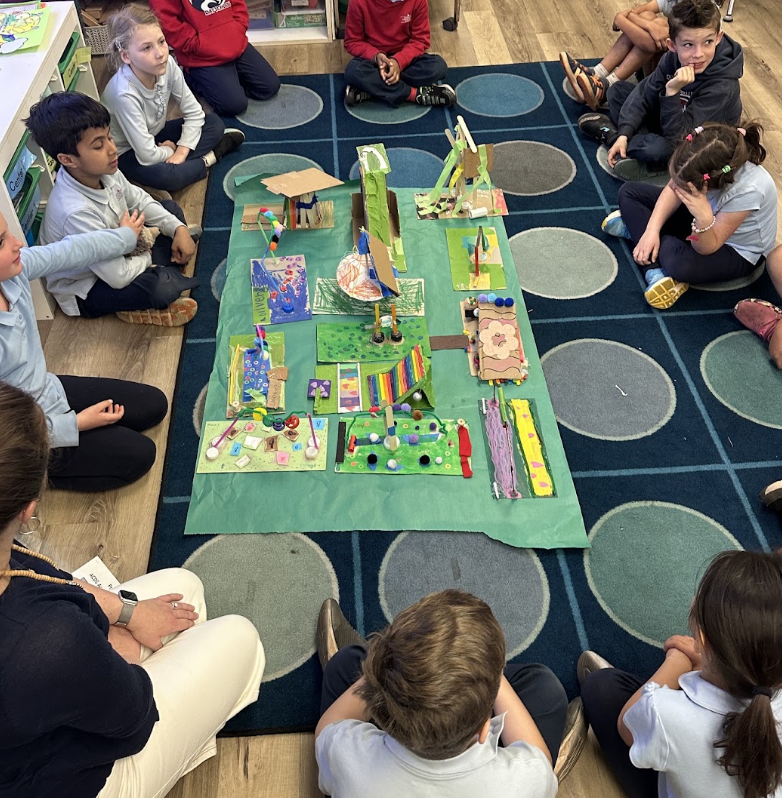
Repeating the Project Year to Year
We have now implemented this project for seven years, with the final product evolving from year to year. We now have a Maker Space teacher, who collaborates with us by facilitating the building of the playground equipment during their scheduled Maker Space time. Partnering with the Maker Space teacher allowed our students to learn about new tools such as Tinkercad to explore 3D modeling and apply them directly to their project. Our Maker Space teacher even introduced the braille alphabet so that students could label their equipment in braille. This collaboration enriched the final project while further teaching about accessible design.
Some years, students have written persuasive letters to school leaders. When time was more limited, students created digital slideshows highlighting different areas of the playground to share with families. This past year, our class co-wrote a letter outlining our hopes and dreams for a future school playground. Our Head of School and Chief Financial Officer visited the classroom, and each student personally presented their model equipment to explain how they had made it accessible. They also reflected on the importance of inclusion, as part of the final project assessment.
Every year, we set expectations early on, reminding the kids that while we are sharing our dreams with the administration, building a brand-new playground is a massive, and complex undertaking. This has never deterred them; children continue to dream big and share their ideas with incredible passion. Even though the playground has never actually been built, our students gain a deep appreciation for making our campus accessible to everyone. Over the years, we’ve had students with diverse accessibility needs. Without ever singling anyone out, their classmates naturally recognize the importance of accessible spaces, and eagerly share their ideas for change with school administration.
At the end of our most recent project, I received an unexpected email from our Chief Financial Officer. He shared how impressed he was with the project and how deeply the students' writing had moved him. He asked to see the photos and details of the Magical Bridge playground we visited, and most exciting of all, he expressed a genuine desire to incorporate accessible equipment into our school’s upcoming playground remodel!
Our school playground renovation is still a few years away. However, when the time comes, our campus will finally be updated with accessible play spaces that reflect our school values of belonging and inclusivity. When the new accessible equipment is installed, every class of first graders who worked on this project will know that their vision left a lasting legacy. Until then, our students walk away with a deep, lifelong understanding of why inclusion matters—which was our ultimate goal from the very beginning.
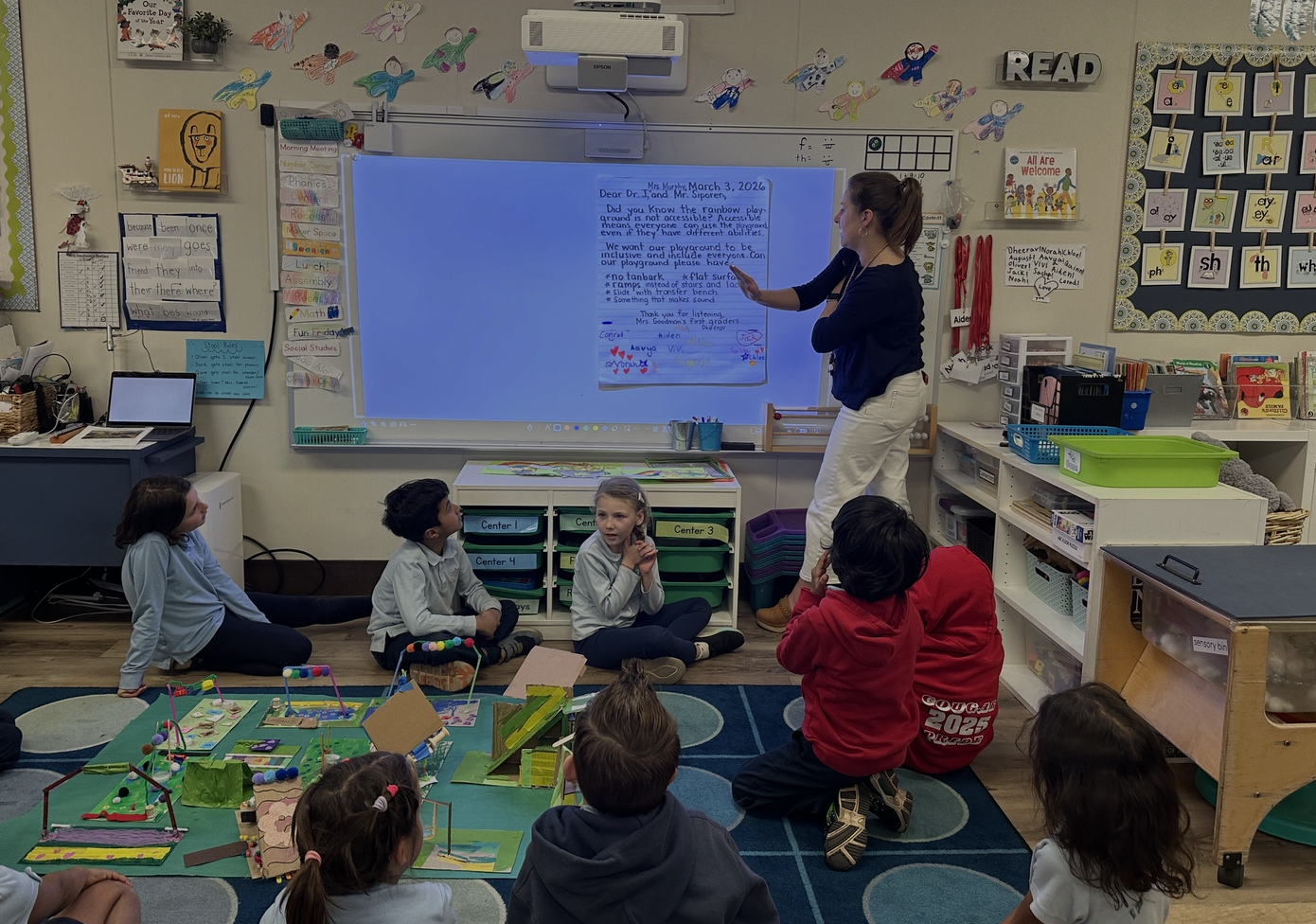
Sharing our letter with administrators
Tips for Implementing this Project
Start with a campus walk. Helping students see familiar places with a new lens allows them to see existing barriers. For example, while touring our playground, we paid close attention to obstacles like the wooden ledge students had to step over and the wood-chip ground covering. Facilitating these observations really helped open students’ eyes.
Collaborate with specialists. We worked closely with our makerspace teacher, who took the lead on helping students bring their designs to life. Partnering with makerspace or science specialists integrates STEM standards and hands-on practices. It also helped ensure students include inclusive elements, like spinning merry-go-rounds or bucket swings with harness straps.
Connect with the community. Reach out to local accessible playgrounds to arrange a group visit and study their equipment firsthand. If you know of individuals or community members who rely on accessible features, invite them to share their experiences. This gives students a human-centered, real-world understanding of why inclusive facilities matter.
Marie Goodman holds a Bachelor’s degree in Art History and Education, as well as a Master of Education from UC Santa Cruz. She credits her teacher preparation program with shaping her philosophy of child-centered, experiential learning. With 17 years of experience teaching kindergarten through third grade across both public and independent schools, Marie is passionate about using research-backed practices to guide her instruction. She thrives on collaborating with her students to bring their unique interests into the classroom community and is thrilled to bring Project Based Learning (PBL) to her new grade level—kindergarten!